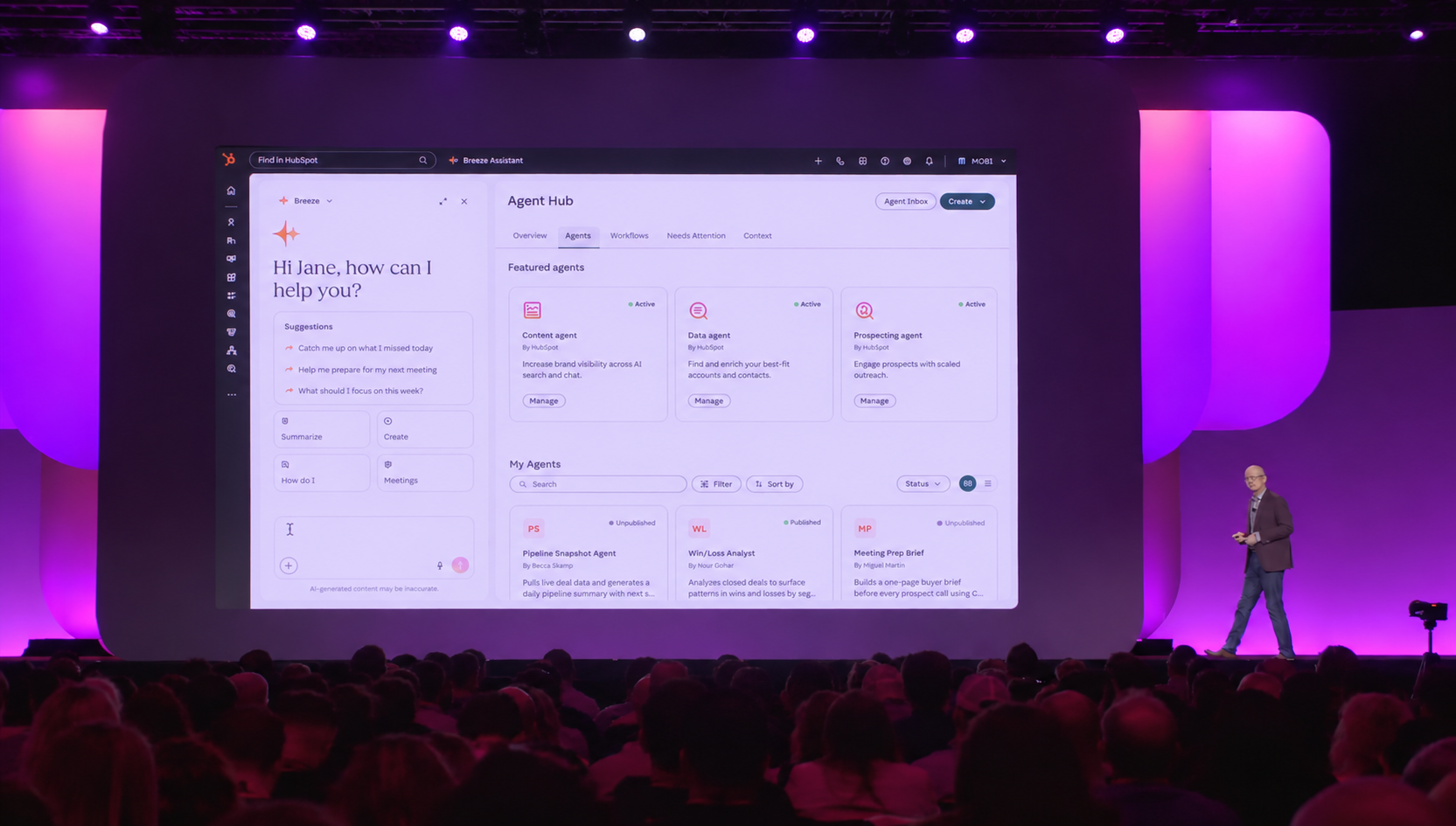
I started by partnering with Agent Hub stakeholders and aligning on the project's principles.

We didn't just need a generic agent icon. We needed a scalable system of iconography, containing distinct, delightful graphics for three different kinds of agents:
First-Party (1P) Agents – HubSpot-built agents, including Nurture Agent, Customer Agent, etc. These agents are native to HubSpot and designed to complete tasks in their product area.
Second-Party (2P) Agents – Agents built by third parties (customers, or app developers) that integrate into HubSpot. Since these could be infinitely generated, their icon system needed to be scalable.
Generic Agents – A symbol to indicate agents generally. We needed to align with the industry on what users associate with agents.
I started with competitor research. How were our closest competitors approaching iconography for agents?

I imagined a HubSpot-ified version of the characters I saw in our competitor's products.


Other options included keeping a consistent agent icon and relying on color to create distinction.


But how would this scale to 2P agents? I tinkered with color variations further.

I collaborated closely with the Agent Hub team and presented options to stakeholders throughout the process. Together we agreed that the color variations did not adequately illustrate the distinct purposes of the agents.
The approach using characters was also axed because it did not align with HubSpot branding.
I searched internally for icons that were used throughout the relevant Hubs. I had nine 1P agents to represent.
A few had pre-existing icons that could be repurposed and others required new ones to be built, including Customer Agent and Nurture Agent.

To preserve the ability to randomize and scale 2P agents, we decided to use initials that would generate for every agent.
Because we had a pre-existing robot icon that aligned well with customer mental models, I decided to rely on that to indicate generic agents.
I built these icons using Adobe Illustrator, then contructed a component in our Figma library so they could be used by designers and developers internally.

We saw massive improvements in scalability, decipherability, and much more compared to the state of agents in 2025.

These results were shared to enthusiastic customers by the CTO of HubSpot at UNBOUND 2026. In 2026, HubSpot has seen a 55% increase in AI adoption in addition to a 3x increase in agentic actions due to investments like this.


